
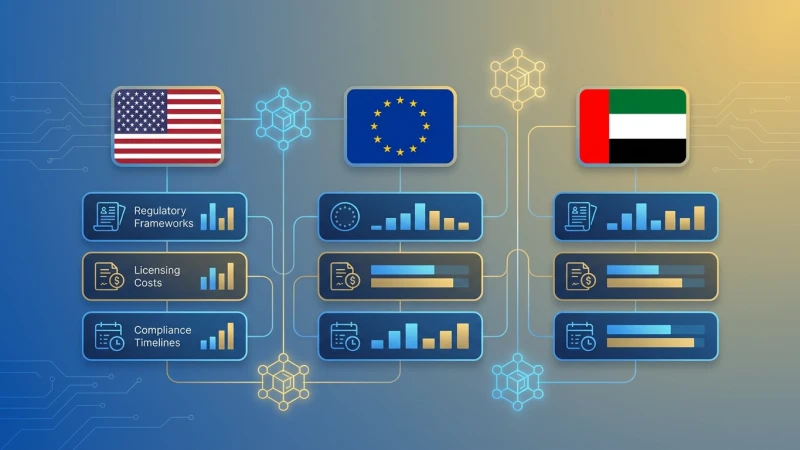
By 2026, three regulatory frameworks will control access to 78% of the global crypto market, and choosing the wrong compliance strategy could cost your business millions in lost opportunities and regulatory penalties. The crypto regulation comparison between the US, EU, and UAE highlights their dominance, as these jurisdictions account for 67% of institutional crypto flow. Understanding the nuances of each framework could mean the difference between strategic growth and costly compliance missteps. In this detailed analysis, you’ll discover the timelines, costs, and strategic opportunities inherent in each regulation, helping your team craft a strong compliance strategy.
2026 Crypto Regulatory market: Three Frameworks Reshaping Global Compliance
Imagine a world where three regulations determine the fate of the $2.3 trillion crypto market. That’s the reality of 2026. The US, EU, and UAE frameworks will not only shape compliance strategies but also influence global crypto trends. These regions’ regulatory frameworks are significant because they ensure a complete and coordinated approach to crypto regulation worldwide. The synchronization of their timelines by 2026 is set to impact businesses heavily invested in crypto ventures.
| Jurisdiction | Market Share | Key Regulatory Body |
| United States | 30% | SEC, CFTC, Treasury |
| European Union | 28% | ESMA |
| United Arab Emirates | 19% | VARA |
US Crypto Regulation Framework: SEC, CFTC, and Treasury Coordination
The US crypto regulation framework stands out for its multi-agency oversight model. The SEC, CFTC, and the Treasury play pivotal roles in ensuring compliance. In 2026, each agency’s specific mandates will coalesce to form a strong regulatory environment. For businesses, this means navigating state-level licensing requirements, understanding stablecoin regulations, and preparing for stringent enforcement and penalties.
The presence of state-level licensing adds another layer of complexity. For example, New York’s BitLicense is infamous for its rigorous demands, while Wyoming offers more lenient requirements. This disparity necessitates a strategic approach when choosing operational locations.
| State | License Type | Requirements |
| New York | BitLicense | Extensive documentation, $5000 fee |
| Wyoming | CSP License | Minimal documentation, $1000 fee |
Recent enforcement cases, such as the SEC’s action against CoinXYZ, highlight the need for compliance. CoinXYZ faced a $1.2 million fine for non-compliance with registration requirements. This underscores the financial risks associated with neglecting proper licensing and regulatory adherence.
EU MiCA Regulation: Complete Implementation Guide for 2026
The EU’s Markets in Crypto-Assets (MiCA) regulation offers a structured and complete approach, set to be fully implemented by 2026. For firms operating within the EU, understanding MiCA’s phased rollout is important. The regulation addresses Asset-Referenced Tokens (ARTs) and E-money tokens, providing a clear framework for compliance.
MiCA is divided into three phases, each with distinct compliance requirements:
| Phase | Timeline | Key Requirements |
| Phase 1 | 2023-2024 | Registration of existing tokens |
| Phase 2 | 2024-2025 | Compliance with ARTs standards |
| Phase 3 | 2025-2026 | Full MiCA compliance, cross-border passporting |
One of MiCA’s most attractive features is the cross-border passporting rights. This allows businesses to operate in multiple EU countries with a single license, reducing costs and complexity. However, the documentation required is extensive, including detailed financial disclosures and risk assessments.
UAE Crypto Regulation: VARA Framework and Free Zone Advantages
The UAE’s approach is characterized by the Virtual Assets Regulatory Authority (VARA) framework, offering competitive advantages for crypto businesses. The UAE is unique in its progressive strategy, combining regulatory rigor with attractive incentives such as tax deductions and operational benefits available in free zones like ADGM and DIFC.
| Zone | Regulatory Body | Benefits |
| ADGM | FSRA | Zero taxes, easy setup |
| DIFC | DIFC Authority | Strong legal framework, zero taxes |
For startups, the UAE’s regulatory sandbox programs provide a unique opportunity to test and scale innovations with regulatory support. These programs simplify the application process and offer a controlled environment to ensure compliance before full-scale operations.
Side-by-Side Framework Comparison: Costs, Timelines, and Requirements
For businesses, a crypto regulation comparison across the US, EU, and UAE is critical to strategic planning. Each jurisdiction presents distinct licensing costs, time-to-market durations, and operational requirements. By evaluating these elements, companies can align their strategies with the most favorable environments.
| Aspect | US | EU | UAE |
| Licensing Cost | $5000 – $10,000 | $3000 – $7000 | $2000 – $5000 |
| Time to Market | 6-12 months | 3-9 months | 1-4 months |
| Operational Needs | State-level variations | Unified under MiCA | Free zone benefits |
For instance, the ROI calculator shows that opting for the UAE can reduce setup costs by 40% compared to the US, with a faster market entry. However, ongoing compliance burdens vary significantly, requiring companies to weigh short-term savings against long-term regulatory commitments.
Regulatory Arbitrage Opportunities and Strategic Considerations
Regulatory arbitrage involves strategically exploiting differences in jurisdictions to improve business operations. In the context of crypto regulation comparison, the US, EU, and UAE offer distinct opportunities for this approach.
For businesses, cross-border structuring strategies can mitigate risks and capitalize on regulatory shopping. For instance, setting up in the UAE while maintaining EU passporting rights could balance compliance costs and market access. Mitigating risks involves staying informed on regulatory changes to ensure that your business remains future-proof.
| Strategy | Opportunity | Risk |
| Cross-Border Structuring | Access multiple markets | Complex compliance |
| Regulatory Shopping | Cost reductions | Potential legal pitfalls |
To fully exploit these opportunities, firms need a dynamic regulatory change monitoring system, ensuring they are agile enough to adapt swiftly to new regulations.
Implementation Roadmap: Preparing Your Compliance Strategy for 2026
Preparing for 2026 means crafting a compliance strategy that adapts to evolving regulatory environments. A 12-month preparation timeline is important for achieving this goal, ensuring adequate resource allocation and vendor selection. Crafting a strategy involves detailed planning, including designing a compliance monitoring dashboard that keeps your team informed and proactive.
Begin by auditing your current compliance status, followed by setting clear objectives and timelines. Resource allocation should focus on both internal skills and external vendors well-versed in regulatory nuances. A strong monitoring system will keep you ahead of compliance issues, providing real-time updates on regulatory shifts.
| Month | Action | Goal |
| 1-3 | Audit & Assess | Understand current position |
| 4-6 | Plan & Allocate Resources | Define strategy and budget |
| 7-9 | Vendor Selection | Choose reliable partners |
| 10-12 | Implement Monitoring System | Stay informed on changes |
With these steps, your team will be well-prepared for 2026, ensuring compliance and strategic advantage in the rapidly evolving crypto market.
FAQs on Crypto Regulation Comparison
How is crypto regulated in 2026? In 2026, crypto is regulated through complete frameworks by the US, EU, and UAE, covering various aspects of digital assets. Each jurisdiction has distinct requirements and enforcement mechanisms, influencing global compliance strategies and providing opportunities for regulatory arbitrage. What is MiCA regulation? MiCA regulation is the EU’s framework for overseeing crypto-assets, including Asset-Referenced Tokens and E-money tokens. It aims to create a unified market for digital assets across Europe, simplifying compliance through cross-border passporting and phased implementation. Which crypto regulatory framework is most business-friendly? The UAE’s VARA framework is considered the most business-friendly due to its tax advantages and simplified licensing processes in free zones like ADGM and DIFC. These regions offer unique incentives, making the UAE an attractive jurisdiction for crypto businesses. What are the compliance costs for each jurisdiction? Compliance costs vary: in the US, they range from $5000 to $10,000; in the EU, from $3000 to $7000; and in the UAE, from $2000 to $5000. Each jurisdiction’s costs include licensing fees, operational requirements, and ongoing compliance commitments. Can crypto businesses operate across multiple jurisdictions? Yes, crypto businesses can operate across multiple jurisdictions by using regulatory frameworks like MiCA’s passporting rights in the EU, and strategic structuring in the UAE. Cross-border operations require careful compliance planning to navigate varied legal requirements.
Your next move? Start by examining your current compliance structure against the frameworks we’ve compared. This proactive step will prepare you for 2026’s complexities, keeping your business ahead and compliant. Stay updated on regulatory shifts and consider consulting with experts to refine your strategies. Visit Valasys Fintech for continuous insights and updates on crypto regulations.