
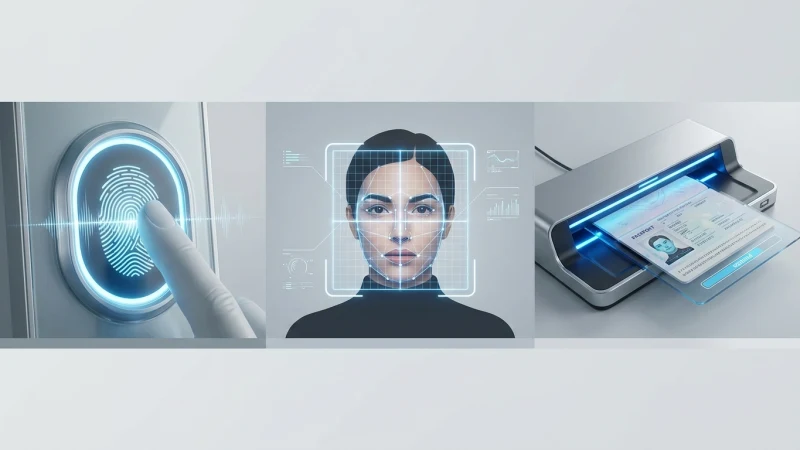
While 67% of businesses still rely on manual identity verification, companies using advanced identity verification technology reduce fraud by 85% and cut verification costs by 60%. But choosing the wrong technology stack can cost millions in compliance failures. In this article, we’re diving into the details of biometric, document scanning, and AI-powered verification technologies. You’ll gain insights into accuracy rates, implementation costs, and regulatory compliance to make an informed decision.
Identity Verification Technology Market Analysis: $15.8B by 2027
Identity verification technology is projected to hit a staggering $15.8 billion by 2027. The growing demand is driven by stringent regulations like GDPR, CCPA, and KYC, which mandate strong identity checks. Identity fraud, costing companies $56 billion annually, further underscores the need for effective solutions. Across industries, technology adoption is on the rise, with financial services leading the charge at an 80% adoption rate.
| Region | Projected Market Size (2027) |
| North America | $5.2B |
| Europe | $4.7B |
| Asia-Pacific | $3.9B |
| Rest of the World | $2.0B |
To calculate ROI for implementing identity verification technology, consider variables like current fraud losses, verification costs, and potential savings. For example, an organization losing $1 million annually to fraud could potentially cut this by 85% using advanced technology, resulting in a $850,000 saving.
Biometric Verification Technology: Accuracy Rates and Implementation
Biometric verification stands out for its high accuracy rates. Fingerprint recognition boasts a 98% accuracy rate, while facial recognition averages 95%. Voice recognition, slightly less precise, hovers around 90%. Despite these impressive stats, false acceptance rates remain a concern, with rates as high as 1 in 1,000 for facial recognition. In terms of liveness detection, biometric systems excel at distinguishing between real and fake inputs.
| Biometric Method | Accuracy Rate | False Acceptance Rate |
| Fingerprint | 98% | 1 in 50,000 |
| Facial | 95% | 1 in 1,000 |
| Voice | 90% | 1 in 500 |
Hardware requirements for biometric systems include sensors and cameras, which can drive up initial costs. However, the accuracy and security benefits often justify the investment. Security vulnerabilities, such as spoofing through photographs or recordings, do exist but are mitigated by advanced liveness detection.
Document Scanning Technology: OCR, NFC, and Advanced Authentication
Document scanning technology use optical character recognition (OCR) and NFC to verify documents. OCR accuracy varies by document type, averaging 85% for complex documents. NFC chip reading adds another security layer, verifying the integrity of the document. Processing speeds are impressive, with systems capable of verifying a document in under 10 seconds, though error rates can be as high as 5% with poor-quality documents.
| Document Type | OCR Accuracy Rate | NFC Capability |
| Passports | 95% | Yes |
| ID Cards | 90% | Optional |
| Driver’s Licenses | 85% | No |
Fraud detection features in these systems include watermark recognition and microprint detection. Processing times are quick, but errors remain a challenge, especially with older documents. Yet, the ability to quickly authenticate documents makes this technology a cornerstone for compliance in industries like finance and healthcare.
AI-Powered Identity Verification: Machine Learning Models and Performance
AI-powered identity verification employs sophisticated machine learning models to improve accuracy and speed. Neural networks, including convolutional and recurrent architectures, are commonly used. These require extensive training data: at least 10,000 labeled data points for effective model training. AI systems excel in real-time processing, offering sub-second verification times.
| Metric | Performance |
| Real-time Processing Time | < 1 second |
| Data Requirement | 10,000+ labeled examples |
| Continuous Learning Capability | Yes |
Continuous learning enables these systems to adapt over time, improving accuracy up to 97%. However, implementing AI verification can be complex, requiring expertise in data science and machine learning. Despite this, the adaptability and high performance of AI models make them a formidable choice for industries facing sophisticated fraud tactics.
Head-to-Head Technology Comparison: Performance Metrics and Costs
When comparing biometrics, document scanning, and AI, clear performance and cost differences emerge. Biometric systems generally offer the highest accuracy, but at a higher hardware cost. Document scanning is cost-effective and quick but struggles with error rates. AI provides exceptional real-time capabilities but requires significant upfront investment in data and model training.
| Technology | Accuracy Rate | Processing Time | Implementation Cost |
| Biometrics | 98% | 2 seconds | High |
| Document Scanning | 85-95% | 10 seconds | Moderate |
| AI | 97% | < 1 second | Variable |
Scalability is another key factor. Biometric systems scale well with hardware investments, while AI systems benefit from cloud-based architectures, offering flexible scalability. Total cost of ownership (TCO) calculations often favor AI over time due to decreasing data processing costs and improved fraud detection capabilities.
Industry-Specific Implementation: Banking vs Healthcare vs Fintech
Different industries face unique challenges and regulatory requirements. Banking, for instance, prioritizes user experience and strong KYC compliance. Here, biometric systems offer the best compromise between security and user convenience. In healthcare, the focus is on accuracy and speed, making AI solutions ideal due to their fast processing times.
| Industry | Priority | Recommended Technology |
| Banking | KYC Compliance | Biometrics |
| Healthcare | Speed & Accuracy | AI |
| Fintech | Scalability | AI + Document Scanning |
Fintech companies, driven by scalability demands, often adopt a hybrid approach, combining AI with document scanning for complete coverage. Compliance checklists for these industries ensure that the chosen technologies meet both regulatory and operational needs, reducing risk and improving customer satisfaction.
Technology Selection Framework: Decision Matrix and Implementation Roadmap
Choosing the right identity verification technology involves a strategic approach. A decision matrix can weigh criteria such as accuracy, cost, implementation timeframe, and vendor reliability. A hybrid approach often yields the best results, combining strengths of multiple technologies to cover all bases.
| Criterion | Weight | Biometrics | Document Scanning | AI |
| Accuracy | 30% | 9 | 7 | 8 |
| Cost | 25% | 6 | 8 | 7 |
| Implementation Time | 20% | 7 | 8 | 6 |
| Scalability | 25% | 8 | 6 | 9 |
Implementing the selected technology requires a clear roadmap, detailing phases like pilot testing, full deployment, and ongoing maintenance. Vendor evaluation is important; assess vendors based on technology fit, support capabilities, and track record. Following this framework ensures a strategic investment that aligns with business objectives.
What is identity verification technology? Identity verification technology is a system or process used to confirm the identity of a person or entity. It typically involves checking identity documents or biometrics, like fingerprints or facial recognition, to verify that someone is who they claim to be. This technology is important for compliance and security in many industries. What are the best identity verification methods for businesses? The best identity verification methods depend on industry needs and regulatory requirements. Biometrics offer high accuracy, document scanning is cost-effective, and AI provides fast, adaptive verification. A hybrid approach often combines these technologies to maximize security and efficiency. How accurate is biometric identity verification? Biometric identity verification is highly accurate, with fingerprint recognition reaching up to 98% accuracy. Facial recognition follows with approximately 95%, while voice recognition achieves around 90%. These systems are reliable for preventing unauthorized access, though they require liveness detection to guard against spoofing. What is the cost difference between identity verification technologies? Costs vary significantly: biometric systems involve high upfront hardware expenses, document scanning is moderate, and AI solutions have variable costs based on data and processing needs. Over time, AI’s TCO can be lower due to efficient data processing and adaptability to new threats.
Start today by applying the decision framework to your business’s unique requirements. Consider your industry-specific needs, current technology stack, and growth plans. This deliberate approach will ensure you choose the best identity verification technology for your organization’s success.
Explore how top embedded finance companies are reshaping financial services and consider how these developments could influence your technology choices.