
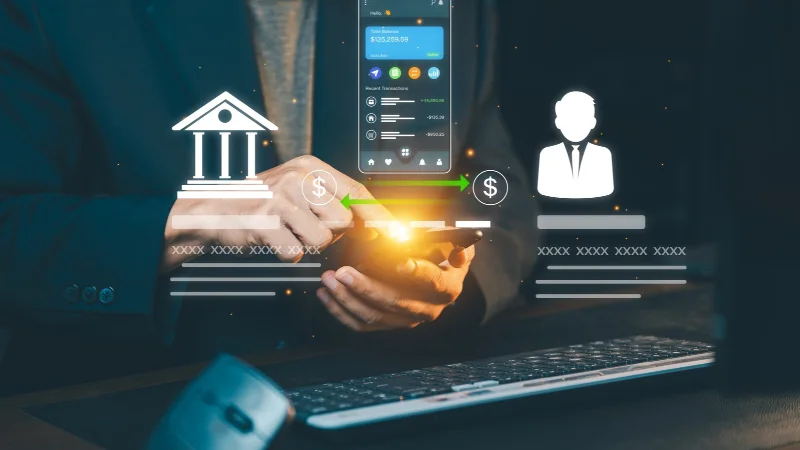
Photograph a check with your phone and the deposit appears in your account before you have left the kitchen. Send a friend money from an app and it arrives in seconds. So what is digital banking, and what actually happens behind the screen?
Digital banking refers to the delivery and management of banking services through digital channels, including mobile apps, websites and integrated financial platforms. These services can include account management, payments, savings, card controls and loan applications, depending on the provider. The idea is the same around the world, but the rules, payment networks and consumer protections differ widely by country and by provider. This guide explains how the system works, what it offers, and how to judge the risks.
Digital banking meaning: more than a banking app
Digital banking is often confused with online banking. Online banking usually means a traditional bank letting customers check balances and move money through a website. Digital banking is broader. It covers the whole experience, including account opening with remote identity checks, card controls, payments, lending and spending insights, all delivered digitally.
Three terms are worth separating:
- Digital bank: a licensed bank whose services are mostly or entirely digital.
- Neobank: a digital-first financial services provider that offers banking-like services primarily through apps or websites. Some operate through partner banks, while others hold their own banking licences.
- Challenger bank: a term commonly associated with newer banks that compete with established institutions, often through digital-first services, innovative products or alternative customer experiences. The term is particularly associated with the UK banking market.
The difference matters because the licence determines who is responsible for your money when something goes wrong.
How digital banking works
A digital banking transaction moves through four stages.
- Request. You start an action in an app, such as paying a bill or transferring savings.
- Authentication. The bank confirms your identity with a PIN, a one-time password (OTP) or a fingerprint or face scan. Many systems also check the device and behaviour, such as an unusual location.
- Core banking processing. The request reaches the bank’s core banking system, the central ledger software that holds balances and applies rules. It checks available funds, limits and compliance flags.
- Execution and notification. The money moves over a payment rail, the network that connects banks, and both parties are notified.
The last step hides an important distinction: a confirmation on your screen is not the same as final settlement between banks.
In the United States, the Automated Clearing House (ACH) network handles payments such as payroll and bill payments, with processing times that depend on the transaction and service used (Nacha). Real-time payment systems, including the Federal Reserve’s FedNow Service and The Clearing House’s RTP network, support payments around the clock, with funds transferred within seconds under normal operating conditions. In the UK, the Faster Payments Service also supports near-instant transfers, although processing times can vary. In India, the Unified Payments Interface (UPI) processed approximately 24.07 billion transactions in September 2026, according to the National Payments Corporation of India (NPCI).
Behind the app, banks increasingly use application programming interfaces (APIs), which allow software systems to exchange data under defined rules. Open banking frameworks, such as the European Union’s Payment Services Directive 2 (PSD2), establish requirements for authorised third-party providers accessing payment-account information or initiating payments, subject to applicable consent and security requirements. The rules and scope of open banking vary by jurisdiction.
Key features of digital banking
Most modern digital banking services include:
- Remote account opening using electronic identity verification and customer due diligence, often referred to as electronic know-your-customer (eKYC), subject to the applicable jurisdiction’s requirements. In the United States, the FFIEC Bank Secrecy Act/Anti-Money Laundering Examination Manual provides guidance on relevant customer identification and compliance controls.
- Fast payments and transfers over local rails such as ACH, FedNow, Faster Payments in the UK or card networks.
- Card controls to freeze a card, set limits or create virtual card numbers for online purchases.
- Automation, including recurring bill payments, scheduled transfers and savings rules.
- Spending insights, with categorised transactions and budgeting dashboards.
- Integrated products, such as loans, investments and insurance, though the range varies widely.
That last point matters. Most neobanks offer deposit products but not lending, so a polished app does not guarantee a full banking relationship.
Benefits of digital banking, and what they cost
The advantages are real. Access is available at any hour, with no queues or paper forms. Costs can be lower because providers avoid branch expenses, though lower fees are not guaranteed everywhere. Real-time balances and alerts make spending more visible.
The commercial side deserves attention too. Digital providers typically earn money through interchange (fees merchants pay on card payments), interest margins on deposits, subscriptions or lending. A free account is rarely free to run. Convenience can also encourage faster spending, because a tap feels less final than handing over cash.
Digital banking vs traditional banking
| Factor | Digital-first bank or neobank | Traditional bank |
| Channels | App and web, with chat support | Branches, phone and digital |
| Account opening | Often fully remote | Remote or in person |
| Product range | Often narrower | Usually broader, including mortgages and business lending |
| Licence | Own licence or partner bank | Own licence |
| Support | Mostly digital | Hybrid, including face-to-face |
Neither model is better in every case. A freelancer making small, frequent payments may value speed and low fees. A business seeking a large loan may still need the relationship a traditional bank offers.
Digital banking security and deposit protection
Digital banking security relies on multiple safeguards, including multi-factor authentication (MFA), biometrics, encryption, device checks and fraud monitoring. The Federal Financial Institutions Examination Council (FFIEC) provides guidance on authentication and access controls for financial institutions. However, these measures cannot eliminate every risk. Common threats include phishing messages, fake customer-support calls and scams that persuade customers to authorise fraudulent payments.
Scammers may use publicly available information, such as names, job titles and social media activity, to make phishing messages or fraudulent bank calls appear legitimate. Customers should verify unexpected requests through official banking channels and never share one-time passwords (OTPs), PINs or login credentials. They should also contact their bank promptly if they notice suspicious activity or authorise a payment under false pretences.
Deposit protection depends on the country, institution and account structure. In the United States, the Federal Deposit Insurance Corporation (FDIC) generally insures eligible deposits up to $250,000 per depositor, per insured bank, per ownership category. In the United Kingdom, the Financial Services Compensation Scheme (FSCS) protects eligible deposits up to £120,000 per eligible person, per authorised firm, under the limit introduced on 1 December 2025. In the European Union, deposit guarantee schemes generally protect eligible deposits up to €100,000 per depositor, per bank, subject to applicable rules. Customers should check the relevant scheme’s eligibility requirements and the institution’s authorisation before opening an account.
When a US fintech provider partners with an FDIC-insured bank, eligible deposits may qualify for pass-through deposit insurance if applicable requirements are met. Coverage is subject to the ownership category, combined balances and other eligibility rules. A fintech provider’s failure is not itself the same as the failure of its partner bank, so customers should understand how their funds are held and what protections apply.
Rules also shape what providers can offer. Licensing, anti-money-laundering controls and data protection requirements differ across jurisdictions, as set out in these fintech licensing requirements. Providers increasingly rely on RegTech compliance automation to manage identity checks and monitoring at scale.
How consumers and businesses use digital banking
For individuals, digital banking now handles paycheck deposits, bill payments, card spending, savings goals and peer-to-peer transfers. Many people deposit checks by photo and rarely visit a branch.
Small businesses use it differently. They collect customer payments, pay suppliers and staff, reconcile accounts against accounting software and track cash flow daily. As they grow, they add automated B2B payments, which cut manual approvals and errors. Companies that trade internationally need to understand B2B cross-border payment solutions, where fees, exchange-rate margins and compliance checks all affect the final cost. Larger finance teams connect their banks to a treasury management system for a single view of cash.
As digital banking evolves, businesses need reliable payment infrastructure, stronger fraud controls and better visibility into cash flow. Explore how Valasys FinTech can help your organisation evaluate relevant fintech solutions. Contact Valasys FinTech to discuss your technology requirements.
Digital banking: convenience with conditions
Back at the kitchen table, the deposit feels effortless. What it hides is a chain of licensed institutions, ledgers, authentication checks and settlement arrangements, each with its own rules and risks. So when you ask what is digital banking, the useful answer goes beyond “banking on your phone.” It is a set of services whose speed and convenience are real, but whose protection depends on who holds your money, which regulator oversees them and how well you recognise a scam. The question worth asking before opening any account is this: if the provider failed tomorrow, who would be responsible for my money?
For a deeper look at the rules behind these services, see this complete guide to fintech compliance.
Frequently asked questions
1. What is digital banking in simple terms?
Digital banking lets you manage money through an app or website instead of visiting a branch. You can open accounts, pay bills, transfer funds, apply for loans, and control cards remotely, usually at any hour.
2. How does digital banking work?
You make a request through the app, the bank verifies your identity, and its core banking system checks your balance and applicable rules. The payment then travels through a payment network. You receive a confirmation, although final settlement between banks may happen later.
3. Is digital banking safe?
Digital banking can be secure when providers implement appropriate safeguards and customers follow good security practices. However, protection varies by provider, and no technology eliminates all fraud risks. Customers should use multi-factor authentication where available, secure their devices and contact their bank promptly about suspicious transactions. The main risks include scams and stolen credentials. Never share one-time passwords (OTPs) or approve payments you did not initiate.
4. Are deposits in digital banks protected?
Deposit protection depends on the provider and country. Licensed banks are often covered by national deposit protection schemes, such as the FDIC in the United States or the FSCS in the United Kingdom. For neobanks, check whether a partner bank holds your money and whether deposit protection applies to your account.
5. What is the difference between digital banking and traditional banking?
Digital banking operates primarily through apps and online channels, while traditional banks combine physical branches with digital services. Traditional banks may offer a wider range of products, while digital banking providers often emphasize convenience, speed, and lower fees.
6. Can small businesses use digital banking?
Yes. Many providers offer business accounts for collecting payments, paying suppliers and employees, monitoring cash flow, and integrating with accounting tools. Before choosing a provider, check transaction limits, fees, international payment options, and licensing in your market.